A real estate developer website has one job: turn people who are curious about a project into buyers who contact your sales team. That is different from an agent’s portal, which lists many properties from many owners, and different from a corporate brochure that only tells your company story. The strongest developer sites give each project its own dedicated page, answer the questions a buyer asks before calling (where, how big, which floor, what delivery date, what financing structure), and make the next step obvious on every screen. This guide explains how to structure that kind of site, what to put on each page, and which technical details quietly decide whether the leads arrive. It is based on how we build sites for developers and property businesses, and on the documented search and performance guidance we link to along the way.
One site for the company, one page for each project
The most common structural mistake is to bury projects inside a single “Our projects” page with a gallery and a paragraph each. A buyer searching for a specific building or neighbourhood needs a page that is about that project and nothing else. Search engines also need it: a dedicated page can carry its own title, description, location text, images and structured content, so it can rank for the project name and for searches around its area. The company site then acts as a hub that links to every project page, and each project page links back to the developer, so both reinforce each other.
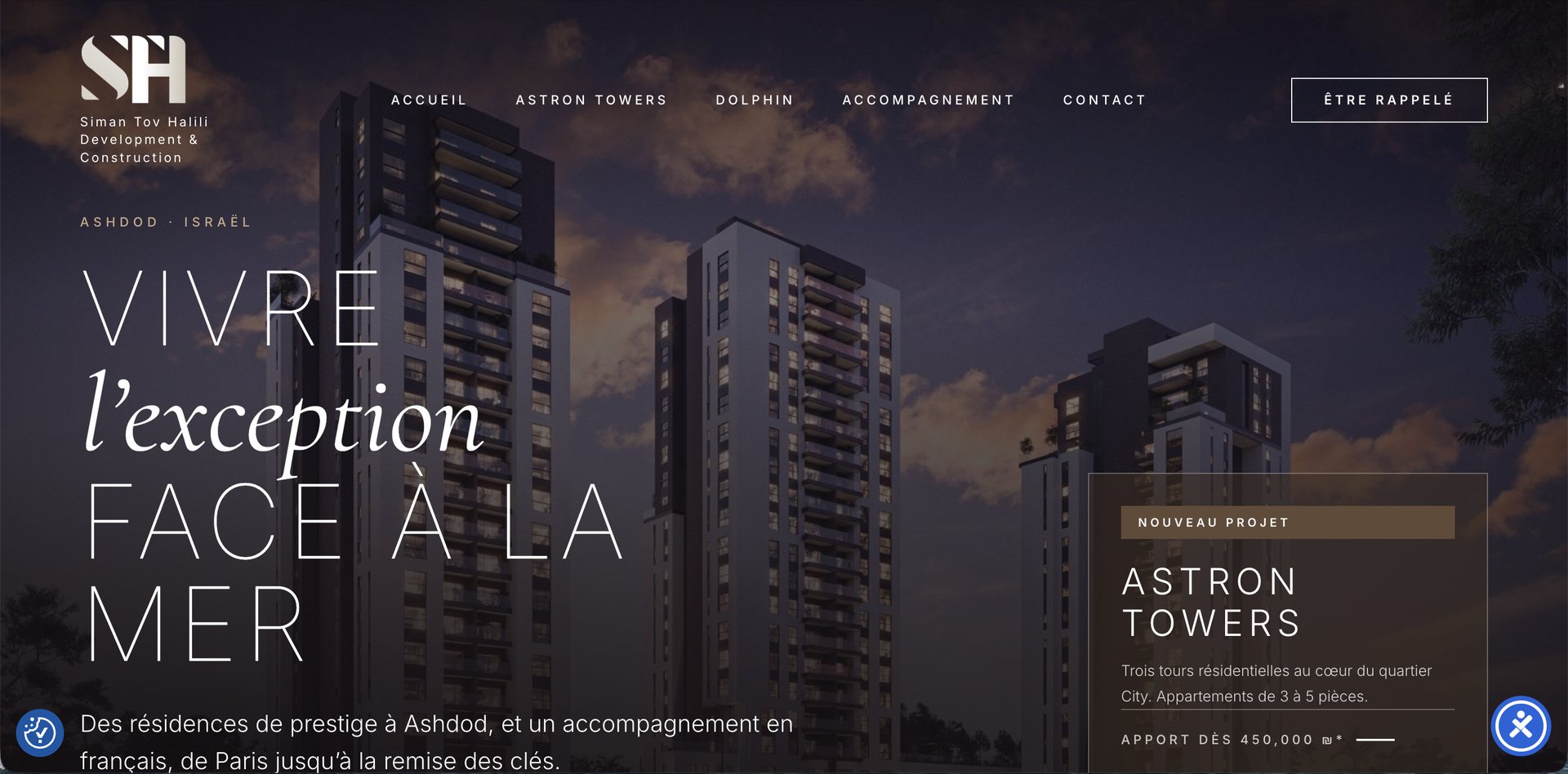
A solid project page opens with a clear summary: the project name, the neighbourhood, the type of units, the stage (planning, under construction, delivered) and one primary action such as “Register interest” or “Book a call”. Below it come the elements buyers actually use to decide: the location with a map and nearby amenities, the number of buildings and floors, the range of unit sizes, the specification, the schedule, and the sales contact. Keep the stage up to date, because nothing damages trust faster than a project shown as “coming soon” two years after construction started. You can see a project-focused site for a residential tower development, Astron Towers, in our work.
Floor plans, availability and pricing: decide what to show
Floor plans are the most consulted content on a property site, so they deserve more than a tiny image. Present each type of unit with a readable plan, the interior and balcony areas, the orientation and the floor range where it is available. Use a downloadable PDF as well, since serious buyers share plans with family, lawyers and mortgage advisers. If you want to know who is downloading, you can ask for a name and phone number before delivering the file, but be aware that every form field reduces the number of people who complete it. A common compromise is to show the plan online freely and to request contact details for the full brochure and price list.
Pricing and availability are strategic decisions rather than design ones. Some developers publish “starting from” prices, others keep prices for the sales conversation, and many show unit availability only to registered visitors. Whatever you choose, the website must never contradict what your sales team says: an availability table that is not updated is worse than none. If your inventory changes often, connect the site to a system your team already maintains, so the page reads from the same source instead of being edited by hand. This is where a custom back office or a lightweight CRM and web app pays for itself, because leads, units and statuses live in one place.
Lead capture that sales teams can actually use
A lead is only valuable if someone follows it up quickly and knows what the person asked for. Give every project page a short form with the minimum fields (name, phone, email, and a preferred contact time or language), add a WhatsApp button and a click-to-call link on mobile, and make sure the form tells your CRM which project the person was looking at. WhatsApp is the everyday messaging channel in Israel, so a button that opens a pre-filled message gives buyers a faster way to reach you than a long contact form. Confirm each submission by email or message so the visitor knows it worked, and test the whole chain regularly, because a broken form fails silently.
If you run paid campaigns for a launch, send the traffic to a dedicated page rather than the home page. A focused landing page for one project removes the navigation, repeats the offer and keeps a single call to action. Landing pages for campaigns usually cost less than a full site; our own ranges are summarised in our guide to choosing a web design agency in Israel. Keep the campaign page consistent with the permanent project page, so that buyers who compare the two do not find different details.
Key takeaway Build one dedicated page per project, show floor plans clearly, keep stage and availability accurate, and connect every form and WhatsApp button to the team that follows up. Speed, mobile layout and the right languages matter as much as the renders.
Speed, mobile and languages: the invisible details
Property sites are image-heavy: renders, drone views, gallery photos and sometimes video. That is exactly why they are often slow. Most buyers first open the page on a phone, and a hero image of several megabytes on a mobile connection can make them leave before seeing anything. Compress and correctly size every image, load galleries and videos only when the visitor scrolls to them, and measure the result with the metrics described on web.dev Core Web Vitals, which cover loading speed, responsiveness and visual stability. Fast pages are better for visitors first, and they also support search visibility.
Language is the other major factor. Many developers sell to local buyers and to foreign or returning buyers in the same project. A well-built bilingual structure, with a separate page for each language and proper hreflang signals as described in Google’s documentation on localised versions, lets each audience find the project in the language they search in. If your market includes Hebrew, remember that the layout must be built for right-to-left reading, not just translated; our guide to the bilingual Hebrew–English website covers it in detail. Add accessibility from the start, following the WCAG guidelines, because retrofitting it later costs more.
Content that builds trust, and what it costs
Buying a unit off-plan is a large and slow decision, so buyers look for proof that the developer will deliver. Show your track record with completed projects, the team and the partners (architect, contractor, legal and financing partners), and keep construction updates visible. Original content wins here: a short article about the neighbourhood, the buying process or the payment schedule answers real questions and brings in search traffic from people who are not yet ready to call. Follow Google’s guidance on helpful, people-first content and write for buyers, not for search engines.
On budget, a professional developer or business website in Israel typically falls between ₪6,000 and ₪20,000 before VAT, and a campaign landing page between ₪3,000 and ₪9,000, as detailed in our article on web design agencies in Israel. A multi-project developer site with a back office, availability management and CRM integration sits above that range, and the quote depends on how many projects, languages and integrations you need. You can browse comparable work on our portfolio, including the STAYS property rental platform and the project sites for developers, and read more practical guides in the journal.
Frequently asked questions
Does a developer need a separate website for each project?
Not necessarily. One company website with a dedicated page per project is easier to maintain and benefits from the company’s overall authority. A separate website makes sense when a project has its own brand, its own domain and a long sales campaign that you want to manage independently.
What should a property project page include?
At minimum: project name and location with a map, unit types and sizes, floor plans, specification, schedule or delivery stage, images and renders, the developer’s track record and a clear way to contact sales through a form, phone or WhatsApp.
Should I publish prices on the website?
It is a commercial decision. Publishing “from” prices filters out unqualified visitors and builds trust, while hiding them can increase enquiries but also frustrates buyers. Whatever you choose, keep the website consistent with what your sales team quotes.
How do I connect the website to my sales CRM?
Form submissions and WhatsApp clicks can be sent to a CRM along with the project the visitor was viewing, so that your team knows what to discuss. This is usually done with an integration or a custom back office, and it should be tested before launch.
How long does it take to build a developer website?
A single-project site with ready content can be built in a few weeks. A multi-project site with availability management, several languages and a CRM takes longer, mostly because of content, renders and approvals rather than development.
Planning a website for your next project? Tell us about the development, the audience and the languages you need, and we will propose a structure that supports your sales team. Contact us to get started, or explore our services.